












Building with Blue BioMass
Building with Blue BioMass will establish a global interdisciplinary network to examine how architectural elements and products can be made from marinebased materials. The project supports the green transition in Denmark and the world. It connects the Danish partners Royal Danish Academy (RDA), Technical University of Denmark (DTU), 3XN/GXN and Arup to complementary blue biomass expertise and research in biomaterial synthesis and characterization, bio-integrated design, bio-economy and advanced manufacture at University College London (UCL), Queensland University of Technology (QUT) and Queensland University (UQ).
A net-zero carbon future depends on decarbonising buildings, however this cannot be achieved using the conventional building materials of today. Instead, it will require a shift to a circular bioeconomy in the building industry. The potential of using locally sourced biogenic materials to create the buildings of the future is significant: construction consumes 40% of all raw materials and produces 40% of the world’s carbon emissions.
Denmark, Australia and the UK are hotspots of untapped marine-based biomass – the raw material resources of coastal vegetative ecosystems and aquacultures including seagrass, macro and micro algae and shellfish. Processing this renewable resource into new materials and high added value architectural products that can sequester carbon in the built environment requires interdisciplinary research.
This network gathers that leading research (currently reaching TRLs 3-5) and is directed towards the rapid expansion of the wider architectural market for biobased materials and biopolymers. It will provide a unique collaborative platform for Danish, Australian and UK-based research and industry to:
- Access the latest research knowledge and innovation opportunities, and share Danish research
- Identify, from the cross-domain perspectives of research and industry, the required next research steps, commercialisation opportunities and patent possibilities.
- Catalyse new research applications at the interfaces of chemical engineering, sustainable architecture, advanced manufacture and biomaterials
Technical University of Denmark, 3XN/GXN, Arup, Bioplastics CRC, Marine Bioproducts CRC, University College London, Queensland University of Technology, UQ IMB
Additive Manufacturing CRC - Innovation Task Force
Additive Manufacturing (AM) CRC’s Innovation Task Force (ITF) – a strategic advisory committee supporting the CRC's mission to build a globally connected, high-performing additive manufacturing ecosystem in Australia. The ITF will play a critical role in accelerating industry adoption of innovation, advising on commercialisation pathways, supporting SME growth, and strengthening Australia’s sovereign manufacturing capability.
ITF Committee role is on
Advising on strategies that foster innovation adoption and impact across Australian industry.
Recommending cross-sector applications and commercialisation pathways for research and intellectual property (IP).
Identifying global trends and best practice case studies in advanced manufacturing.
Supporting the education and training program by aligning workforce development with current and future industry needs.
Uplifting SMEs through collaboration, engagement, and innovation support.
UQ/CSIRO Project - Secure and Ethical XR-Based HSE Training for First Responders in Crisis Situations
Project context
However, the use of XR for HSE training raises several security, privacy, and ethical concerns1,2,3. Firstly, XR environments allow for the real-time collection, storage, usage, and sharing of both active (biometrics, behaviour, identity) and passive (surrounding environment) sensitive information1, and a lack of informed consent and privacy options limits users’ ability to protect their privacy in accordance with their preferences4.
Project Aim and Objectives
Designing for Safety: Evaluating Design Configurations for Total Artificial Heart Systems
Project Description
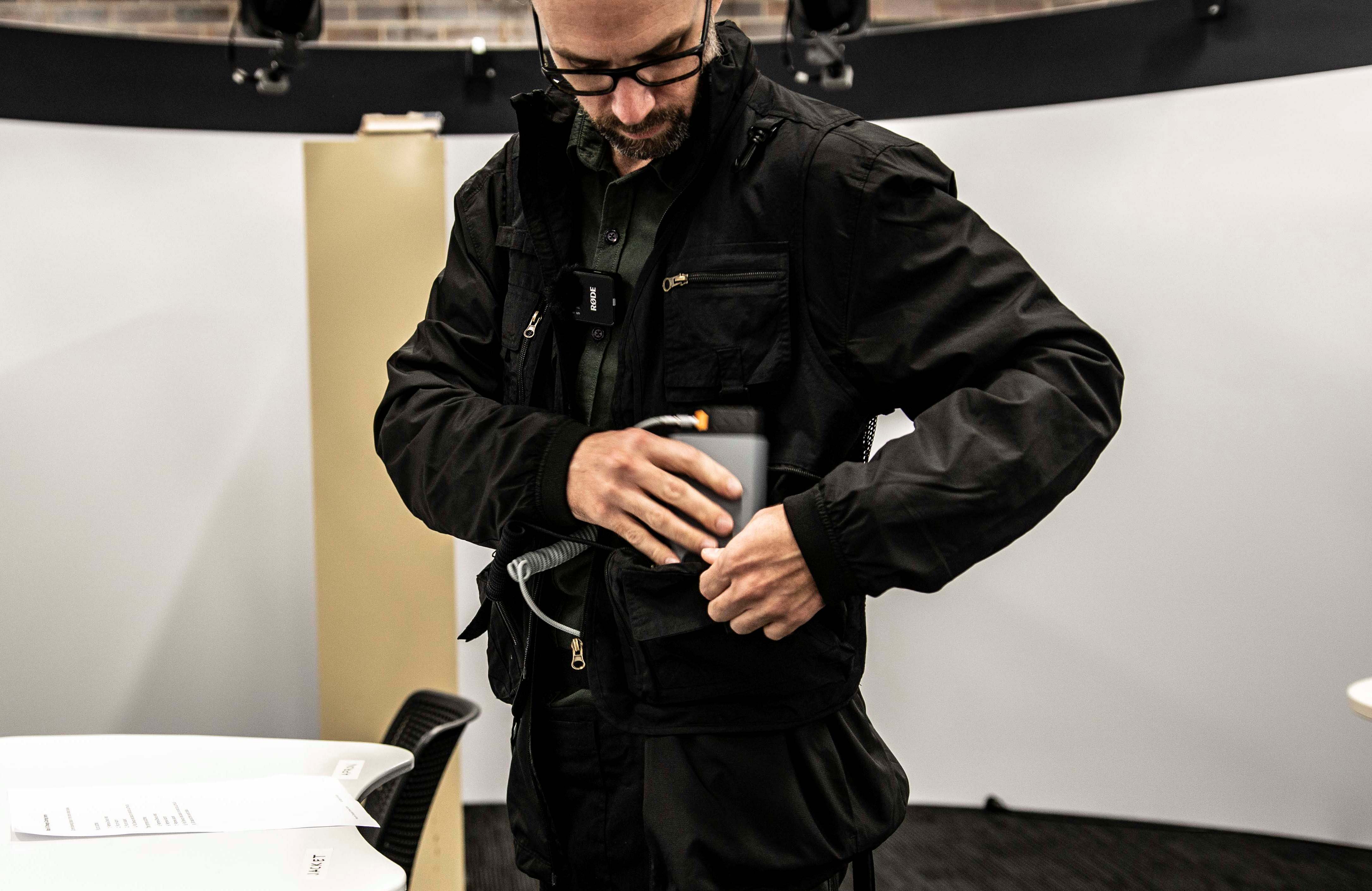
This project investigates the usability, safety, and user preferences of alternative design configurations for a Total Artificial Heart (TAH) system. Responding to established challenges in Mechanical Circulatory Support (MCS) devices—particularly issues of weight, cable management, and interaction complexity—we examine how different configurations perform across both everyday and high-risk scenarios.
Advancing current MCS evaluation approaches, the study embeds device testing within representative, embodied task environments. This enables a more realistic and rigorous understanding of patient interaction, cognitive load, and risk exposure within the context of daily life. The work forms part of the broader Artificial Heart Frontiers Program (AHFP), further details of which can be found at https://ahfp.monash.
Use of the VisLab
The VisLab was central to the methodological rigour of the study and the applicability of the findings because it enabled the controlled simulation of representative environments while maintaining high-fidelity observation and data capture. As a result, we could progress usability testing toward a more situated, human-centred evaluation framework, and thus capture the complexity of real-life MCS device use and generate actionable design insights for safer, more intuitive system configurations.
Project Team
Dr Tom Davidson, Post Doc in the Design Discipline, is leading the study.
Supported by Professor Cara Wrigley, Leon Fitzpatrick, and Dr Genevieve Mosely.
D³ Living Lab
The D³ Living Lab is a multidisciplinary research hub within the School of Architecture, Design and Planning, bringing together expertise in digital innovation, data analytics, and design-led research to address pressing challenges in the built environment.
Positioned as an applied and experimental platform, the Lab connects academic staff, HDRs, and external partners to co-develop solutions that are actionable, scalable, and aligned with industry and community needs. The D³ Living Lab will serve as the foundation for establishing a future research centre, strengthening ADP’s research identity and impact across UQ and the Indo-Pacific region.
VisLab advances digital twin collaboration with Cross River Rail
The UQ Visualisation Laboratory, VisLab, has taken an important step in strengthening its industry-engaged digital twin research through the signing of a Non-Disclosure Agreement with Cross River Rail, facilitated through Dr Jurij Karlovsek.
The agreement creates a secure foundation for exploring Cross River Rail’s digital twin data within VisLab’s immersive research environment. Cross River Rail is one of Queensland’s most significant infrastructure projects, delivering a 10.2 kilometre rail line with 5.9 kilometres of twin tunnels beneath the Brisbane River and CBD, alongside four new underground stations.
This collaboration aligns strongly with VisLab’s research mission: to transform complex spatial data into shared visual intelligence. The Cross River Rail digital twin brings together GIS, BIM and 3D modelling to support planning, coordination, design review and decision-making across a major urban infrastructure system.
Dr Jurij Karlovsek’s expertise in geotechnical and underground engineering strengthens the collaboration, linking VisLab’s immersive visualisation capability with advanced infrastructure knowledge and tunnelling research.
For VisLab, the agreement opens a valuable pathway for research into digital twins, urban analytics, infrastructure communication and immersive decision support. It also positions UQ to contribute to the future of transport infrastructure by helping researchers, industry partners and stakeholders better understand complex underground and city-scale systems.