
UQ VisLab recently welcomed Brett Beeson from PhiSaver for a discussion exploring opportunities to connect high-resolution energy monitoring with UQ’s ongoing digital twin research.
The visit brought Brett Beeson together with Liam McNamara and Chloe Budd from UQ Strategic Partnerships – Government and Industry, Dr Jurij Karlovsek from the School of Civil Engineering, Qianbin Xu from the School of ADP and Associate Professor Fred Fialho Teixeira, Director of UQ VisLab.
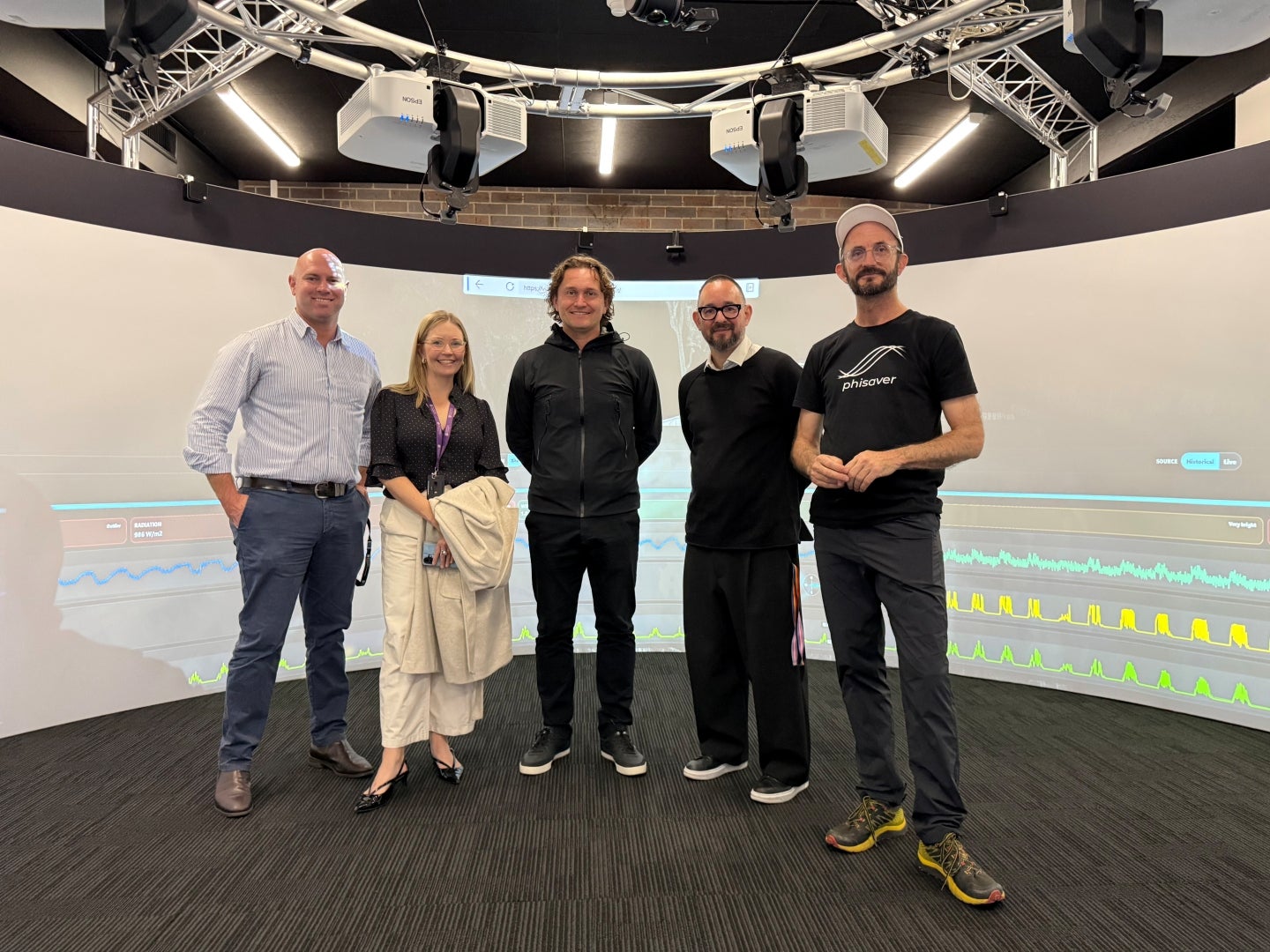
Fred Fialho Teixeira and Jurij Karlovsek introduced the Digital Twin of UQ St Lucia Campus, discussing its development as an integrated digital representation of the campus that brings together spatial, infrastructure, historical and real-time information. Current research is exploring how these interconnected datasets can support predictive modelling, interactive spatial experiences and more informed approaches to infrastructure and campus management.
Building on this, Brett Beeson introduced PhiSaver’s energy monitoring capabilities and discussed how more detailed real-time and historical energy data could complement the UQ Digital Twin. PhiSaver provides sub-circuit energy monitoring that enables electricity use to be understood at a considerably finer level than overall building consumption.
The discussion explored how these data could move beyond energy monitoring and visualisation alone. By connecting detailed energy information with spatial, occupancy, environmental and other operational datasets, the Digital Twin could provide new ways to identify patterns, investigate relationships, support prediction and ultimately inform more effective operational and infrastructure decisions.
Following the broader campus-scale discussion, Fred Fialho Teixeira and Qianbin Xu demonstrated a developing VisLab Spatial Twin within the laboratory’s immersive visualisation environment. The demonstration provided a more detailed example of how spatial digital twins can integrate an interactive representation of the physical environment with live sensor data, connected devices and other real-time information.
The conversation also touched on the potential application of these approaches to larger infrastructure and major-event contexts, including opportunities associated with Brisbane 2032.
This finer-grained demonstrator enabled discussion around how environmental conditions, equipment and data streams can be associated directly with the spaces and assets they describe, creating an interactive environment for exploring data integration, visualisation, spatial interaction and analysis. It also demonstrated how detailed spatial twins developed within VisLab could complement the broader campus-scale UQ Digital Twin research.
The visit provided an opportunity for PhiSaver, UQ VisLab and the wider UQ Digital Twin team to exchange ideas around the role of high-resolution energy data within digital twins and to explore potential directions for future research and collaboration.


