
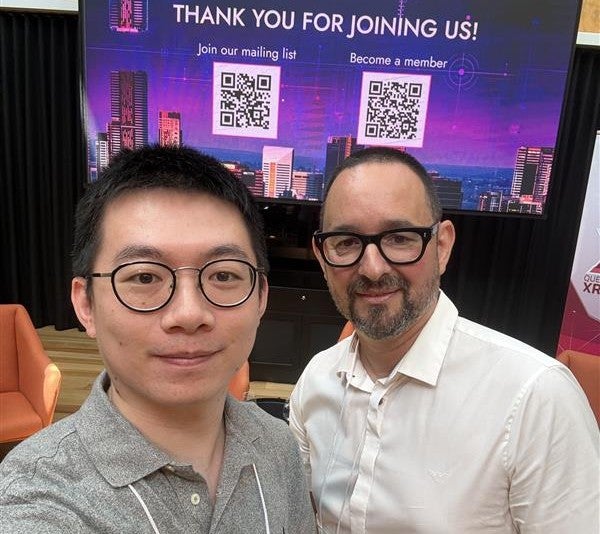
The Queensland XR Hub hosted Field of Vision: An Immersive 2032 in Fortitude Valley, bringing together researchers, industry and government partners to explore how immersive and spatial technologies can shape Brisbane 2032. UQ VisLab Director Associate Professor Fred Fialho Teixeira spoke on the panel "Who Gets to Build on the Digital City?", and attended the event with VisLab researcher Dr Qianbin Xu.
Moderated by Kate Raymond, CEO of Master Electricians Australia, the panel brought together Associate Professor Fialho Teixeira, Betty Moinet from Esri Australia and Richard Simpson, Founding Director and CEO of Meta Moto. The discussion explored how digital infrastructure built for the Brisbane 2032 Olympic and Paralympic Games could leave a lasting legacy, and who should own, connect and build on it.
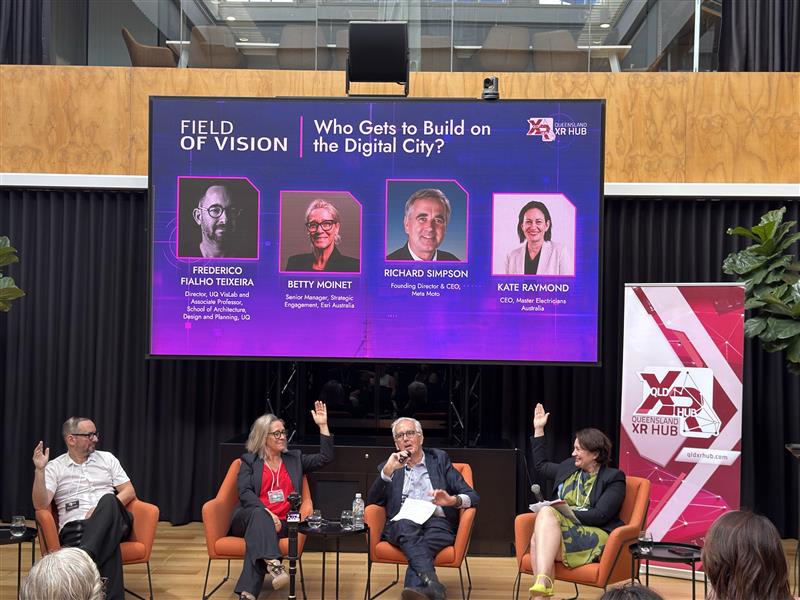
The panellists agreed that the main challenge is no longer data or technology, but how systems, organisations and levels of government connect. Richard Simpson drew on the digital twin developed for Cross River Rail, where the project was treated as two products of equal value, one digital and one physical. Betty Moinet highlighted the need for a trusted spatial foundation shared across transport, venues, utilities and emergency services.
Assoc Prof Fialho Teixeira emphasised that cities are built by people, and any digital platform should work for people through data organisations already hold. He presented the UQ St Lucia Campus Digital Twin as an example, bringing terrain, buildings, underground utilities, mobility, occupancy and energy data into one shared spatial environment. "It's not ten dashboards. It's one spatial element," he said, noting that the platform grew from grassroots collaboration across the University rather than asking individual enitites to change their workflows.
Audience questions covered up-front funding, the valuation of digital assets, and the coordination needed across Games venues and infrastructure. The panel closed with a shared message that clear leadership and a common vision will be critical as Queensland prepares for 2032.
The VisLab thanks the Queensland XR Hub, the panellists and the audience for a lively discussion, and looks forward to continuing these conversations with industry and government partners.


