
The UQ VisLab recently hosted a visit and discussion bringing together representatives from Springfield City Group with UQ colleagues to explore opportunities for future collaboration around digital twins, smart cities and urban development. The group included Dr Richard Eden Executive General Manager, Education & Smart City,and Meera Honan General Manager, Education and Training from Springfield City Group; Peter Hyland, Stephanie Wyeth and Qianbin Xu from UQ’s School of Architecture, Design and Planning; and Caroline Stott and Mahala Predo from UQ Strategic Partnerships, Government and Industry.
During the visit, Assoc Prof Fred Fialho Teixeira introduced the group to research and technologies being developed and explored through the VisLab, including the Digital Twin of UQ St Lucia Campus, immersive visualisation, spatial data integration and interactive 3D environments. The UQ Digital Twin brings together spatial, historical, real time and predictive information to model campus conditions including mobility, building occupancy, infrastructure and environmental performance, while providing a pilot for extending spatially enabled digital twin methods to broader urban applications.
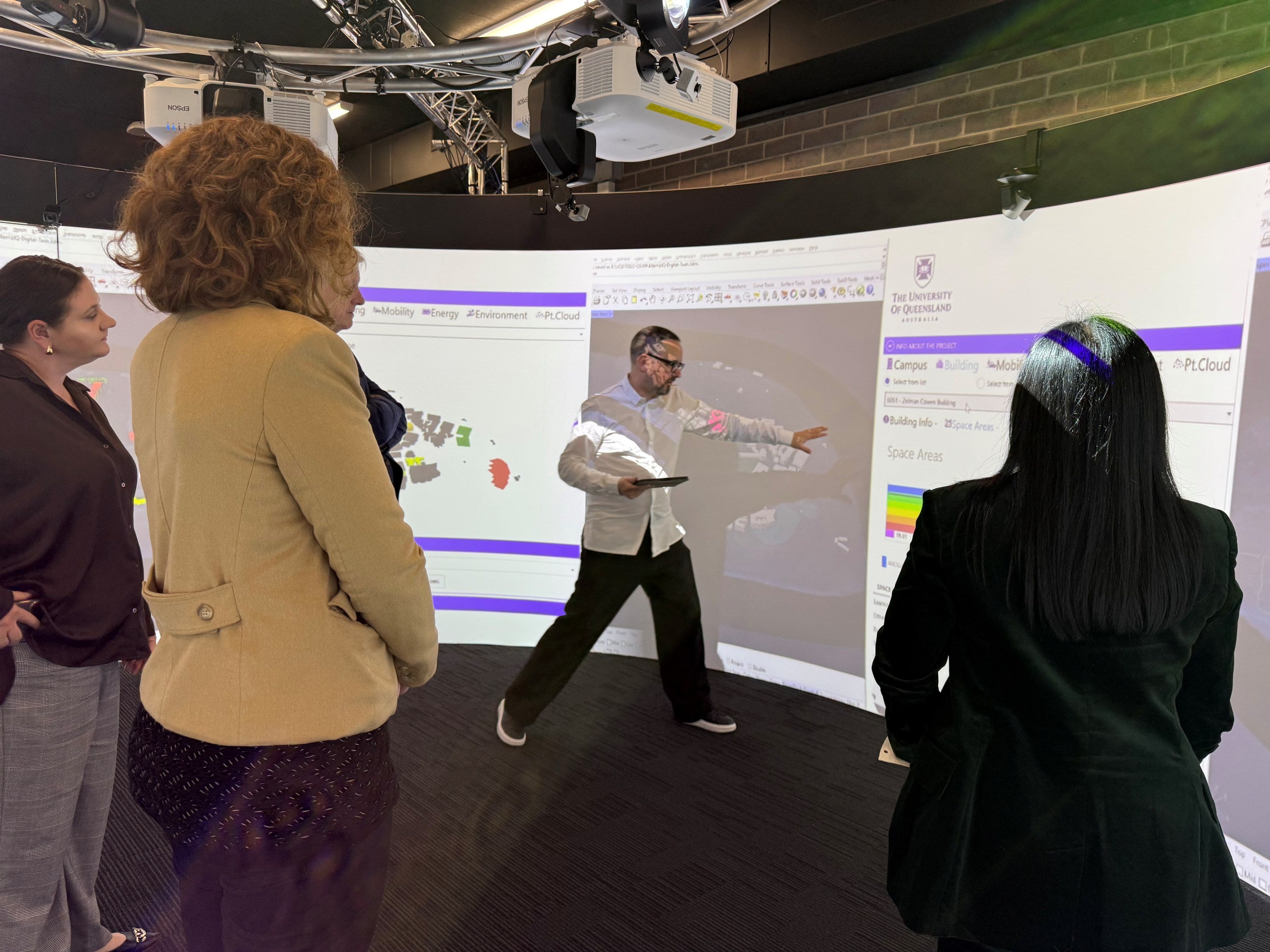
The visit also provided an opportunity to discuss these approaches in relation to Springfield City and its continuing development as an urban, education and innovation precinct. The conversation considered how urban scale digital twins could bring together planning, infrastructure, environmental and operational information within a shared spatial environment. Such an approach could support scenario testing, development planning and communication of future urban conditions while allowing different datasets and spatial relationships to be examined collectively.
More broadly, the discussion highlighted areas where the VisLab can support research and engagement through urban digital twins, data visualisation, immersive experiences, real time and spatial data integration, 3D model visualisation and predictive spatial workflows. These capabilities provide different ways of bringing complex datasets together and allow researchers, government and industry partners to explore urban systems through interactive and experiential environments. The VisLab’s current research explicitly includes 4D spatial intelligence, digital twins, large scale 3D data and data visualisation.
The visit established a valuable basis for further discussion between Springfield City Group, UQ Architecture, Design and Planning and UQ Strategic Partnerships, Government and Industry. UQ VisLab thanks Dr Richard Eden PSM, Meera Honan, Peter Hyland, Stephanie Wyeth, Caroline Stott and Mahala Predo for contributing to the conversation and exploring how UQ’s digital twin research and spatial visualisation capabilities could inform future collaboration at precinct and city scales.
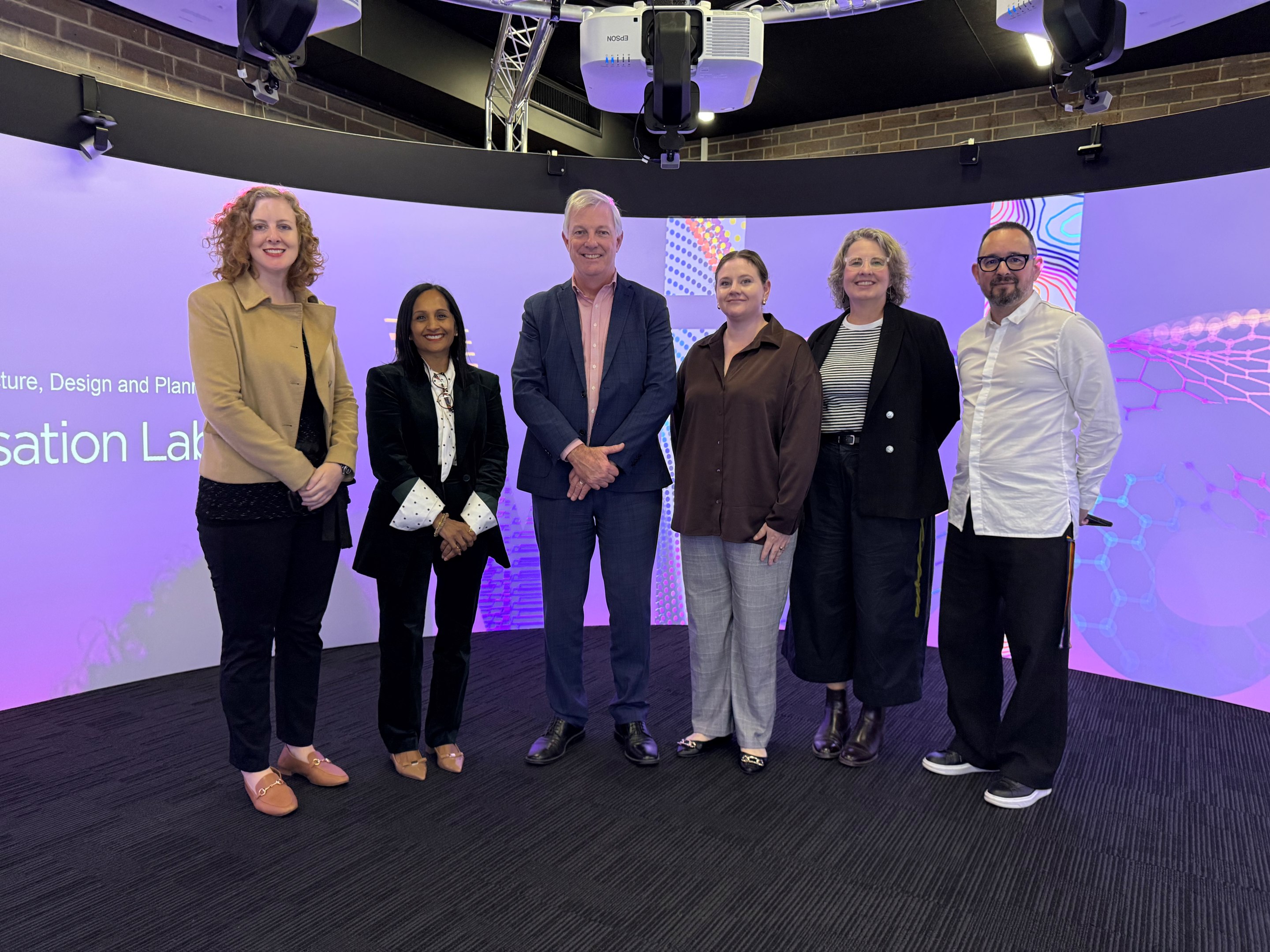
Hero image: Representatives from Springfield City Group, UQ Architecture, Design and Planning and UQ Strategic Partnerships, Government and Industry during their visit to the UQ VisLab.


